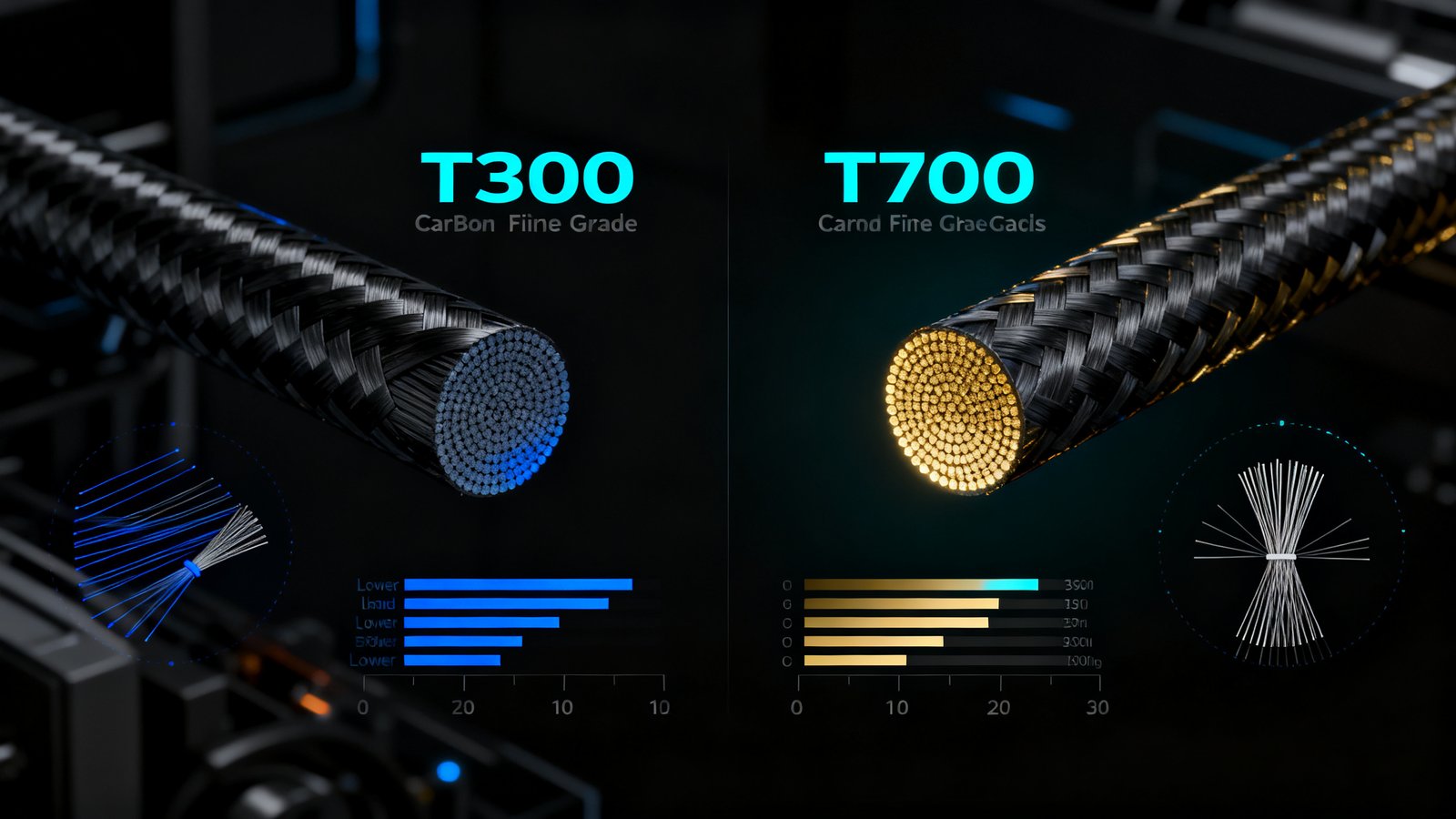
Selecting the wrong grade is the most common — and costly — mistake in carbon fiber procurement. T300 and T700 differ dramatically in mechanical performance, application scope, and price despite the seemingly small numerical gap.
───
Understanding the Toray Grading System
The global carbon fiber grading standard originates from Toray (Japan), with the following naming convention:
T
- Meaning: Tensile Strength series
M - Meaning: High Modulus series
Numbers - Meaning: Performance tier — higher = better
⚠️ Note: T300 and T700 are Toray product codes that have become industry-wide performance benchmarks. Even non-Toray materials are classified by “T300-grade” or “T700-grade” based on their mechanical properties.
───
T300 vs T700 — Key Parameter Comparison
Tensile Strength - T300 Grade: ≥ 3,530 MPa
- T700 Grade: ≥ 4,900 MPa
- Notes: T700 is ~39% stronger
Tensile Modulus - T300 Grade: 230 GPa
- T700 Grade: 250 GPa
- Notes: T700 is ~9% stiffer
Elongation at Break - T300 Grade: 1.5%
- T700 Grade: 2.0%
- Notes: T700 is more ductile, less brittle
Density - T300 Grade: 1.76 g/cm³
- T700 Grade: 1.80 g/cm³
- Notes: Virtually identical
Available Tow Sizes - T300 Grade: 1K / 3K / 6K
- T700 Grade: 3K / 6K / 12K
- Notes: T700 has broader spec range
Price - T300 Grade: Lower
- T700 Grade: ~1.3–1.5× T300
- Notes: T700 carries a premium
Primary Use - T300 Grade: General parts, cosmetic
- T700 Grade: Structural, load-bearing
- Notes: Key selection criteria
───
Choose T300 When:
✅ Cosmetic panels — visual carbon weave display, no structural load
✅ Light-duty structural parts — static loads, ample strength margin
✅ Cost-sensitive high-volume production
✅ Prototype / pilot stage — validating design, not pushing performance limits
✅ Secondary / auxiliary structural parts
Choose T700 When:
✅ Core load-bearing structures — beams, columns, brackets carrying primary loads
✅ Safety-critical components — human safety is at stake
✅ Strict lightweighting requirements — must hit a specific strength at a given weight
✅ Cyclic/fatigue loading environments — T700’s higher elongation = better fatigue resistance
✅ Large-format composites — thicker layups require T700’s strength for interlaminar bonding
───
The 3-Step Selection Method:
1️⃣ Define the load → Perform stress analysis to determine minimum required tensile strength
2️⃣ Apply safety margin → 1.5× for safety-critical parts; 1.2× for general parts
3️⃣ Optimize cost → Select the lowest grade that still meets your strength requirement
Bottom line: No “right” or “wrong” grade — only whether it matches your application. The core principle: sufficient performance, safety first, cost under control.