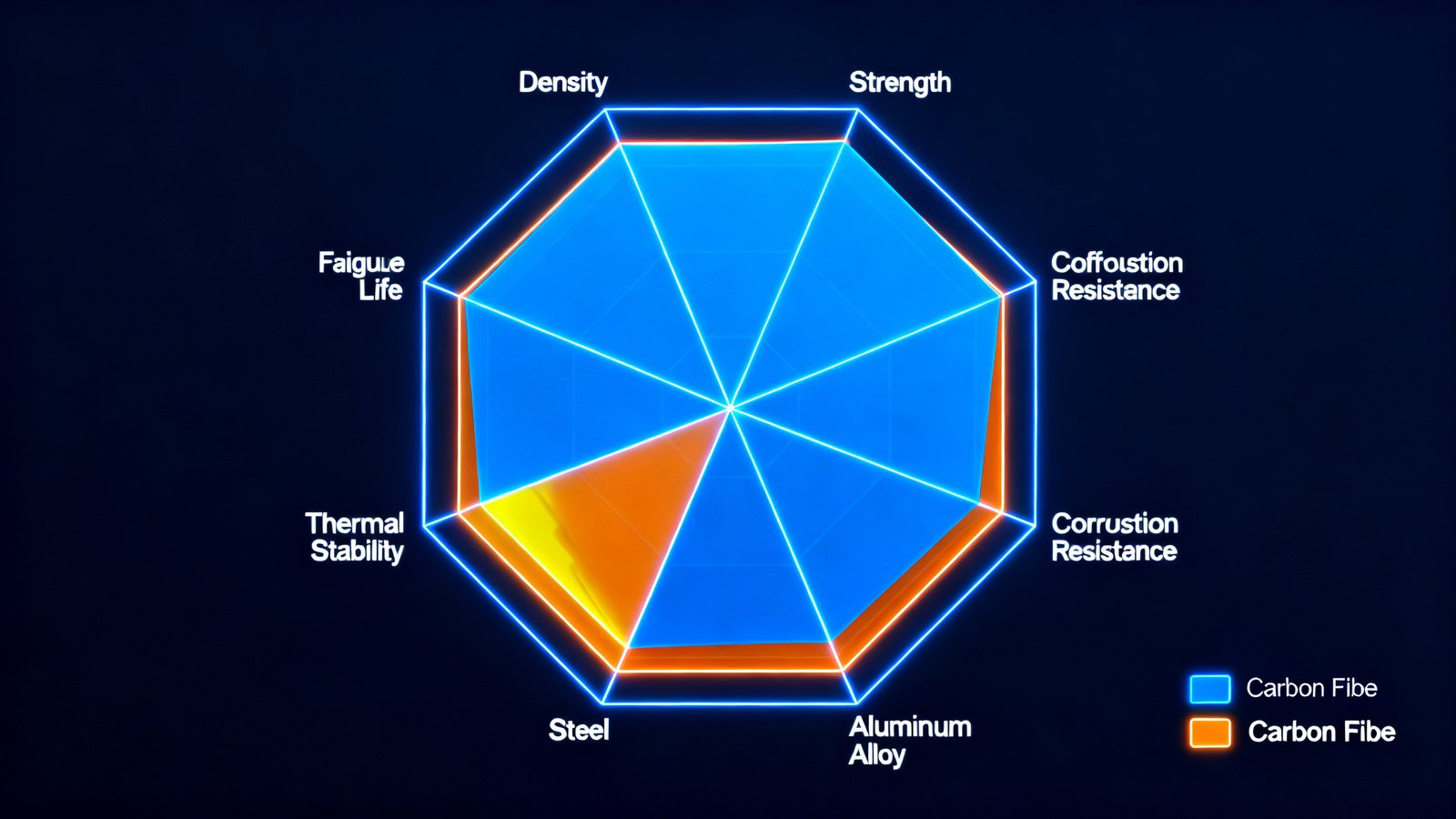
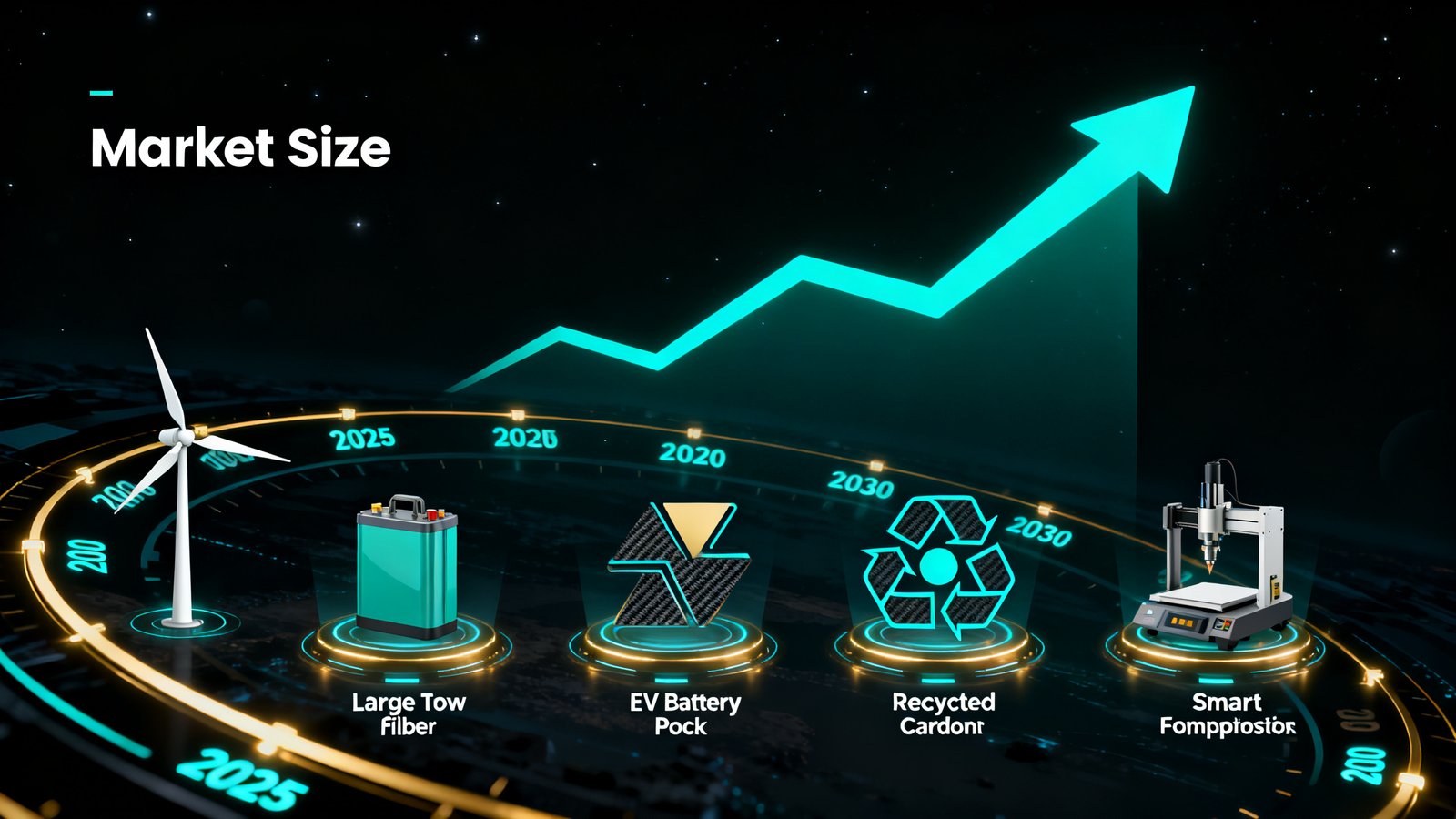
Global carbon fiber market size reached approximately $3.6–3.8 billion in 2024, projected to exceed $7 billion by 2030, with a CAGR of 10–12%. China has surpassed Europe to become the world’s second-largest carbon fiber consumer.
Three Core Market Drivers:
⚡ New Energy Revolution — EV range anxiety → battery pack lightweighting → CF demand surge
🌱 Carbon Neutrality Targets — Cross-industry pressure to decarbonize → structural lightweighting is mandatory
🌀 Wind Power Scaling — Longer blades (100m+) require carbon fiber Spar Caps — no alternative exists
───
6 Major Trends in Depth
📈 Trend 01: Domestic CF Manufacturers Are Rising Fast
Japanese Toray, US Hexcel, and German SGL once dominated. Chinese leaders — Jilin Chemical Fiber, Zhongfu Shenyou, Hengtian — are closing the gap fast:
- T300 and T700 are now at mass production scale
- T800+ grades are entering commercialization
- Some products match international quality at significantly lower cost
💡 For buyers: Domestic CF’s cost-performance advantage is growing. Incorporate domestic sourcing into your procurement strategy and monitor T800+ certification progress.
───
📦 Trend 02: Large-Tow CF Is the New Growth Engine
Wind turbine applications center on 24K/48K large-tow carbon fiber, with costs 20–30% lower than small-tow. This is the preferred choice for large-format composites like wind blades and solar mounting systems.
Small tow (1K–6K) - Typical Applications: Aerospace, precision structures
- Characteristics: Highest performance, highest cost
Medium tow (12K–24K) - Typical Applications: Industrial, sporting goods
- Characteristics: Balanced performance/cost
Large tow (24K–48K) - Typical Applications: Wind blades, pressure vessels
- Characteristics: Lowest cost, best for scale
───
♻️ Trend 03: Carbon Fiber Recycling Is Going Industrial
Carbon fiber composite recycling has been a long-standing industry challenge. Growing volumes of end-of-life wind turbine blades and aerospace parts are driving a recycling market: - Recycled carbon fiber (rCF) costs 40–60% of virgin CF
- Primary uses: construction reinforcement, automotive secondary structures, 3D printing fillers
- Market size projected to exceed $500 million by 2028
───
🖨️ Trend 04: Carbon Fiber + 3D Printing Convergence
Carbon fiber-enhanced 3D printing is a fast-moving technology: - Short-carbon-fiber composite filaments (nylon base + 15–20% CF) work in standard FDM printers
- Continuous fiber 3D printing enables localized reinforcement at 60%+ lower cost than conventional layup
- Ideal for: small-batch customization, rapid prototyping, complex monolithic structures
───
🧠 Trend 05: Smart Composite Materials Are Emerging
Functional CFRP is moving from lab to commercial:
Self-sensing CF - Description: Sensors embedded in layup for real-time stress/strain monitoring
Self-healing CF - Description: Microencapsulated resin repairs micro-cracks autonomously
EMI-shielding CF - Description: Special coatings provide 60 dB+ electromagnetic interference shielding
───
💰 Trend 06: Cost Reduction Breakthroughs Continue
Industry consensus: In the next 5–10 years, total CF system cost is expected to drop 30–40%. This will mark the transition from “high-end specialty material” to “industrial standard.”
───
Strategic Recommendations for B2B Buyers
Design ahead - Action: Integrate CF thinking at the design stage — don’t wait until metals can’t meet requirements
Build supplier relationships - Action: Partner with technically capable CF suppliers for long-term supply security
Track domestic alternatives - Action: Monitor certification progress of high-grade domestic CF to accelerate qualification
Consider rCF - Action: Recycled CF for non-critical secondary structures reduces cost and boosts ESG profile
Invest in talent - Action: CF application requires cross-disciplinary expertise — structural design + process + materials