Positioning Differences
The three most common structural materials in manufacturing have fundamentally different use cases:
- Steel — Lowest cost, most mature processes; suitable where strength is needed but weight is not a constraint
- Aluminum — A middle-ground compromise between weight and cost; for projects with moderate weight sensitivity and budget awareness
- Carbon Fiber — Highest performance but highest cost; for applications where lightweighting is a core requirement or where combined performance demands are extreme
───
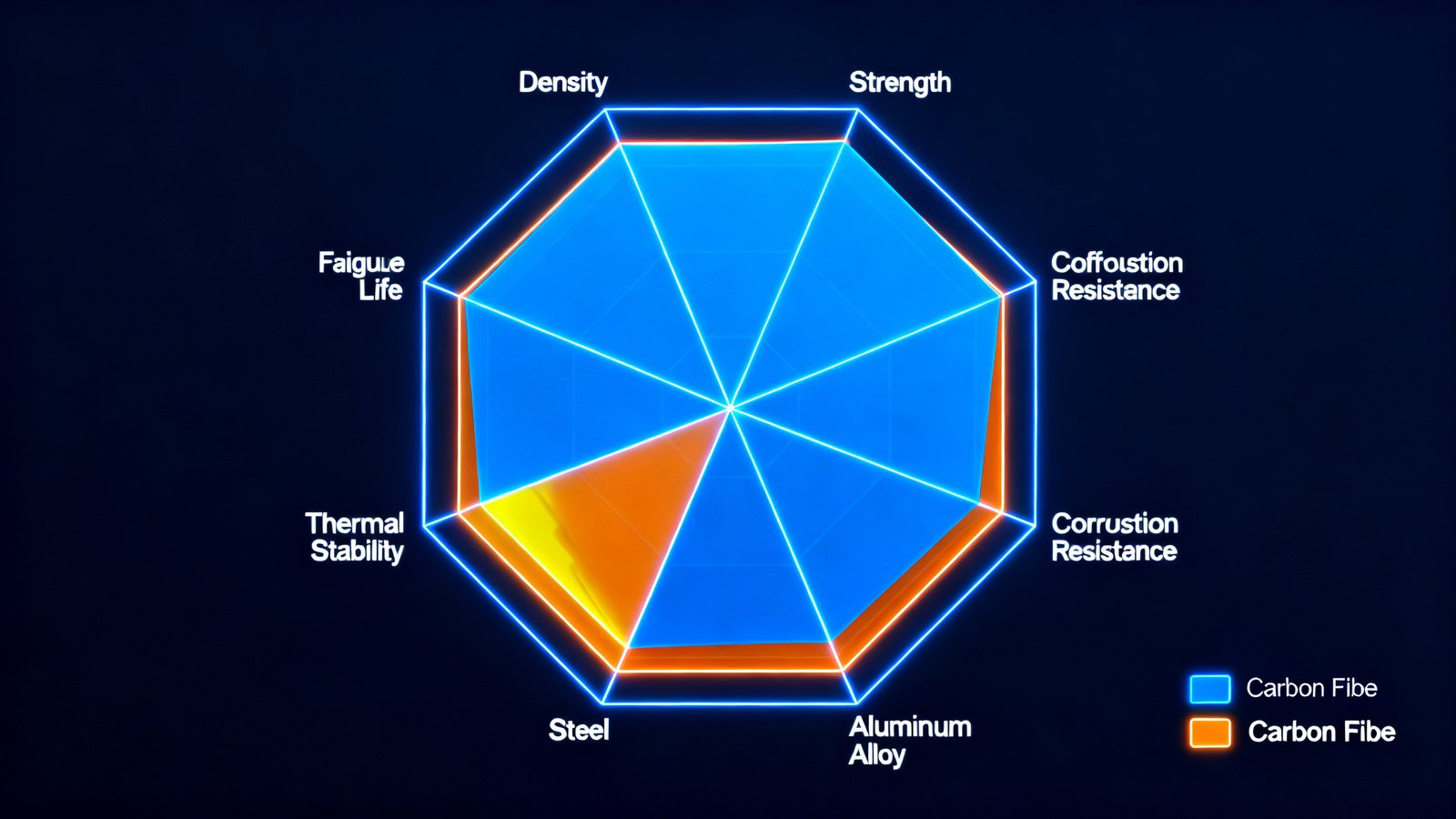
Direct Performance Comparison
Density - Carbon Fiber (T700/UD): 1.80 g/cm³
- Aluminum (6061-T6): 2.70 g/cm³
- Steel (Q355): 7.85 g/cm³
- Winner: CF
Tensile Strength - Carbon Fiber (T700/UD): 4,900 MPa
- Aluminum (6061-T6): 310 MPa
- Steel (Q355): 470 MPa
- Winner: CF
Specific Strength - Carbon Fiber (T700/UD): 2,722 MPa/(g/cm³)
- Aluminum (6061-T6): 115 MPa/(g/cm³)
- Steel (Q355): 60 MPa/(g/cm³)
- Winner: CF (24× aluminum)
Tensile Modulus - Carbon Fiber (T700/UD): 250 GPa
- Aluminum (6061-T6): 69 GPa
- Steel (Q355): 206 GPa
- Winner: Steel
Specific Stiffness - Carbon Fiber (T700/UD): 139 GPa/(g/cm³)
- Aluminum (6061-T6): 26 GPa/(g/cm³)
- Steel (Q355): 26 GPa/(g/cm³)
- Winner: CF (5× metals)
Corrosion Resistance - Carbon Fiber (T700/UD): Excellent (resin-protected)
- Aluminum (6061-T6): Moderate
- Steel (Q355): Poor (needs coating)
- Winner: CF
Thermal Expansion - Carbon Fiber (T700/UD): Near-zero (layup-tunable)
- Aluminum (6061-T6): 23×10⁻⁶ /°C
- Steel (Q355): 12×10⁻⁶ /°C
- Winner: CF
Fatigue Performance - Carbon Fiber (T700/UD): Excellent
- Aluminum (6061-T6): Moderate
- Steel (Q355): Good
- Winner: CF
Material Cost - Carbon Fiber (T700/UD): High
- Aluminum (6061-T6): Medium
- Steel (Q355): Low
- Winner: Steel
Design Freedom - Carbon Fiber (T700/UD): Extremely high (layup-custom)
- Aluminum (6061-T6): Moderate
- Steel (Q355): Low
- Winner: CF
💡 Specific strength is the real story: Carbon fiber’s specific strength is 24× that of aluminum and 45× that of steel. This is why lightweighting engineering prioritizes carbon fiber — at equal weight, it carries dramatically more load.
───
Application-Based Selection Guide
🔋 EV Battery Pack Enclosures → CFRP or Aluminum
Carbon fiber can reduce weight 40–60%, directly extending range. Aluminum is a strong cost-performance alternative. Both must pass挤压 and穿刺 safety tests.
🏗️ General Industrial Frames & Brackets → Aluminum or General CFRP Sheets
Weight sensitivity is lower here. Aluminum’s cost advantage dominates; CFRP sheets offer quick processing with decent lightweighting.
🔭 High-Precision Optical Instrument Supports → Carbon Fiber (specific modulus design)
Only CFRP can simultaneously deliver near-zero thermal expansion, high stiffness, and long-term dimensional stability for precision optical applications.
🏢 Structural Reinforcement in Construction → CFRP Wraps or Steel
CFRP wraps offer fast, lightweight retrofit construction; steel remains the cost-efficient choice for new builds with established connection methods.
───
⚠️ Break free from “material unit price” thinking. Evaluate total cost of ownership:
Initial material cost + Processing cost + Assembly cost + Corrosion protection/maintenance + Life-cycle cost + Indirect benefits of lightweighting (energy savings, throughput gains, etc.)