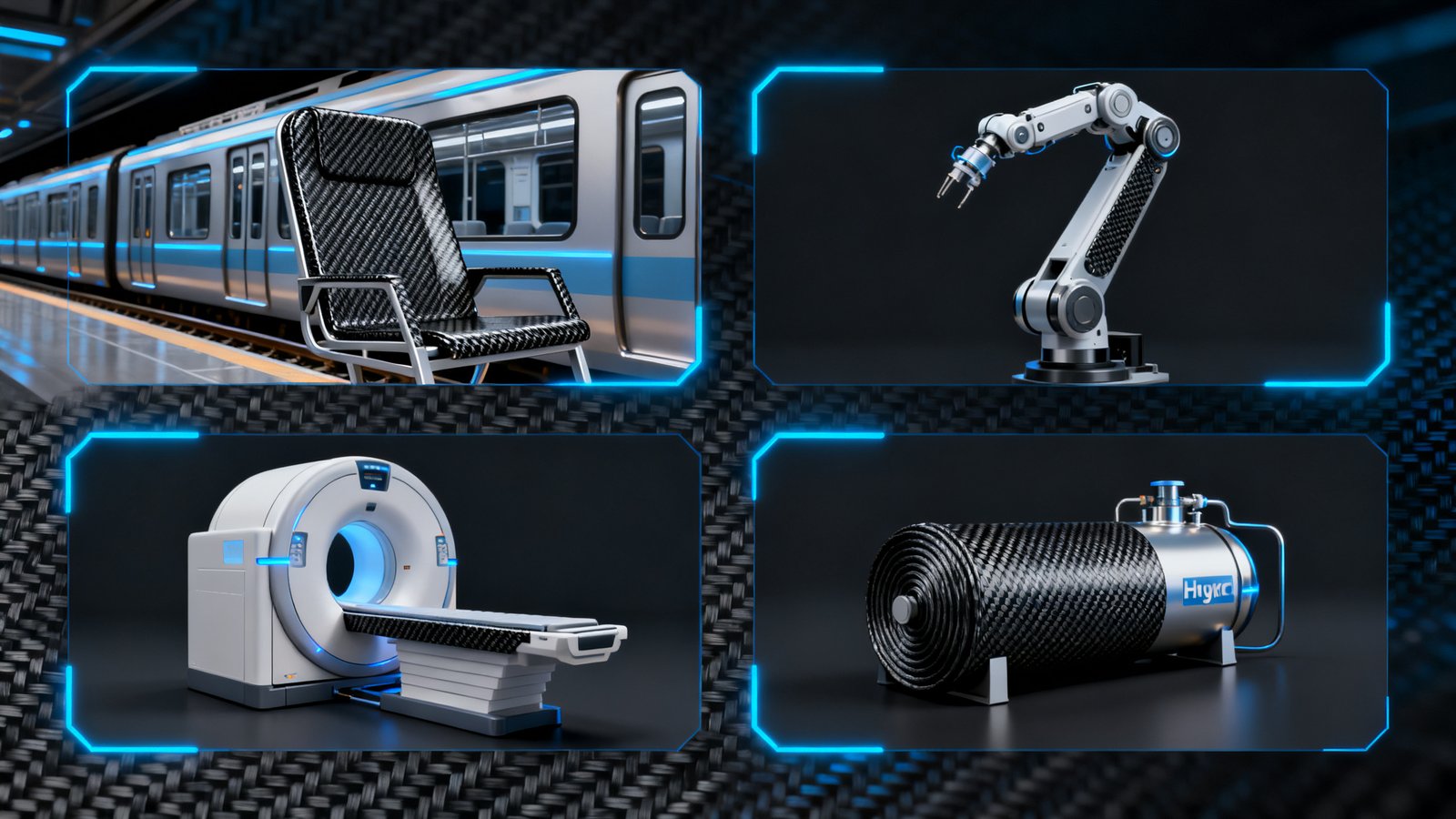
Case 01 — Rail Transit Luggage Rack
Background: A rail vehicle manufacturer needed to reduce vehicle weight for improved energy efficiency, replacing aluminum alloy luggage racks with CFRP.
Solution: T700 carbon fiber fabric + epoxy prepreg, hot-press molding + CNC finishing, multi-axis layup design for optimized strength distribution.
Component Weight
- Aluminum (Original): 28 kg
- CFRP (New): 11 kg
- Improvement: 60.7% lighter
Assembly Method - Aluminum (Original): Welding + Bolting
- CFRP (New): Embedded nut bonding
- Improvement: 40% faster assembly
Corrosion Resistance - Aluminum (Original): Requires regular maintenance
- CFRP (New): Maintenance-free
- Improvement: LCC significantly reduced
───
Case 02 — High-Speed Robotic Arm End-Effector Frame
Background: A robotics company developed a new generation of high-speed assembly robots; the end-effector frame required low weight, high stiffness, and fast vibration damping.
Solution: T700 unidirectional (UD) carbon fiber fabric, hot-press molding + anodized surface treatment, simulation-assisted layup design to maximize stiffness-to-weight ratio.
Frame Weight - Aluminum (Original): 6.2 kg
- CFRP (New): 2.8 kg
- Improvement: 55% lighter
First Natural Frequency - Aluminum (Original): 82 Hz
- CFRP (New): 156 Hz
- Improvement: +90%
Positioning Accuracy - Aluminum (Original): ±0.08 mm
- CFRP (New): ±0.04 mm
- Improvement: 2× more precise
Vibration Damping Time - Aluminum (Original): 450 ms
- CFRP (New): 120 ms
- Improvement: 73% faster
💡 Key insight: Carbon fiber delivers not just “lighter weight” — but combined improvements in stiffness, precision, and dynamic response that are unattainable with metals.
───
Case 03 — Medical CT Scanner Internal Support Structure
Background: A CT equipment manufacturer needed internal support frames with excellent X-ray transmission (reducing image artifacts), high strength, and long-term dimensional stability.
Solution: T300 carbon fiber fabric + radiolucent thermoplastic resin, compression molding with controlled low thermal expansion.
Results: - X-ray transmission improved by 35%, effectively reducing radiation dose
- Frame weight reduced by 45%, lowering foundation load requirements
- 10-year dimensional change rate < 0.02%, outstanding long-term stability
───
Case 04 — Hydrogen Fuel Cell Vehicle Onboard Storage Tank
Background: Hydrogen fuel cell vehicles demand onboard storage systems capable of withstanding 70 MPa pressure, extreme lightweighting, and uncompromising safety.
Solution: T700 carbon fiber filament-winding yarn + low-viscosity epoxy resin, filament winding + PTFE liner coating, full validation: leak testing, burst pressure, and fatigue life testing.
Results: - Single-tank hydrogen capacity increased by 20% at equivalent weight
- Tank weight reduced by 70% vs. steel tanks
- Certified under multiple domestic and international safety standards